

Super Shipping for WooCommerce includes several general settings that directly affect how the plugin behaves.
You can configure these settings in the edit screen of each Super Shipping method you add to a shipping zone.
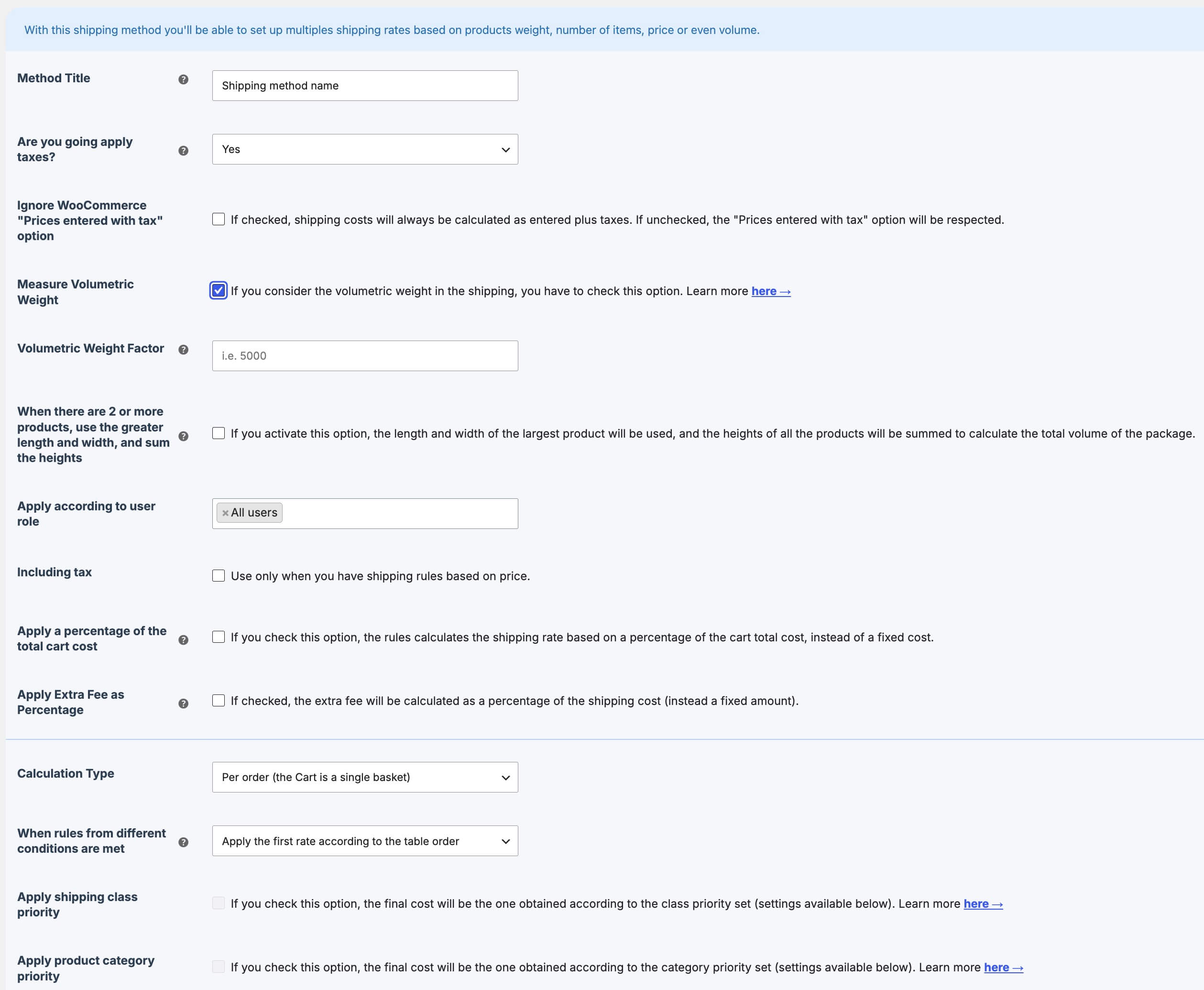
Below, we'll go through these settings and explain what each one does:
- Method title. This is the title customers will see on the cart and checkout pages, alongside the calculated shipping cost.
- Are you going apply taxes? This field allows you to choose whether or not to apply taxes to the calculated shipping costs. When taxes are enabled, the rates you enter will be treated as tax-inclusive or tax-exclusive, depending on your configuration in the Tax tab of WooCommerce settings. (You can override this behavior by unchecking the checkbox that appears when you select “Yes”.) Therefore, if you choose to apply taxes to shipping costs and have also disabled the “prices entered with tax” option in WooCommerce, the corresponding tax will always be added to the shipping rates you enter.
- Measure Volumetric Weight. This option is used when you want to take volumetric weight into account when calculating shipping costs. If enabled, a new field will appear where you can enter the Volumetric Factor (provided by your shipping carrier), which will be used in the calculation.
Volumetric Weight is only considered with shipping rules based on weight. - Volumetric weight factor*. Here, you must enter a number provided by your shipping carrier to calculate the volumetric weight. Super Shipping currently calculates volumetric weight using the following formula: Length (cm) × Width (cm) × Height (cm) / Volumetric Factor. However, if a shipment contains multiple products, you can enable an option that changes how the calculation works: the length and width are taken from the largest product, while the heights of all products are added together to calculate the total package volume more accurately.
- Apply by user rol. This field allows you to specify which user roles this shipping rate will apply to.
By default, the rate applies to all users, but in some cases, you may want to set different shipping rates depending on the type of customer.
For example, you could set a standard shipping rate for regular customers and a special, lower rate for distributors who place much larger orders. - Including tax. This checkbox only applies when the shipping rules in the table are based on price. When enabled, product prices including tax will be used to calculate the shipping cost, as taxes will be included when evaluating the price ranges you have configured. (We'll explain how to use this option in the “Shipping rates by Price” section of the Advanced Configuration guide.)
- Apply percentage of the cart total cost. If you enable this option, shipping rules will apply a percentage of the total cart value instead of a fixed cost. For example, a shipping rule with a cost value of 10 means that the shipping cost will be 10% of the total cart value.
- Apply extra fee as percentage. If enabled, the extra fee will be calculated as a percentage of the shipping cost instead of a fixed amount. For example, an extra fee of 20 means that the final shipping cost will be the rate calculated from the shipping rules plus an additional 20% of that rate.
- Calculation type. This field determines the calculation method used to calculate shipping costs based on the shipping rules tables. It's important to choose the method that best suits your needs.
There are 3 different types of shipping calculations:
– Per Order (the cart is a single basket) -> This is the most commonly used calculation method (you probably won't ever need to change it). Shipping costs are calculated based on all the products in the cart, taking into account the general settings and the conditions defined in the shipping rules.
– Per Item Line (each product in the cart is a basket) -> This calculation method is typically used in special cases where each product is shipped in a separate package. It treats each product (regardless of the quantity added) as if it were in a separate cart.
– Per Shipping Class (when shipping classes are used) -> This is the option you must always select when using shipping classes. Otherwise, Super Shipping will not take into account the shipping classes assigned to products. - Apply shipping class priority. This checkbox only applies if you have selected the calculation method based on shipping classes. If enabled and you have defined shipping class priorities, the plugin will apply the shipping cost of the highest-priority class. You can find more information by clicking here.
- Apply product category priority. This checkbox only applies if you have selected the calculation method based on product categories. If enabled and you have defined category priorities, the plugin will apply the shipping cost of the highest-priority category. You can find more information by clicking here.
* Volumetric weight is a measurement used by courier agencies when there is a significant difference between the volume of the package (the space it occupies) and its actual weight. For example, a plastic shelf may occupy a lot of space but weigh very little. In such cases, shipping would be calculated based on its volumetric weight. More information here.
Additionally, there are other general settings available in the “Super Shipping for WooCommerce” tab under “WooCommerce > Settings > Shipping”. These settings only appear when Super Shipping is activated:
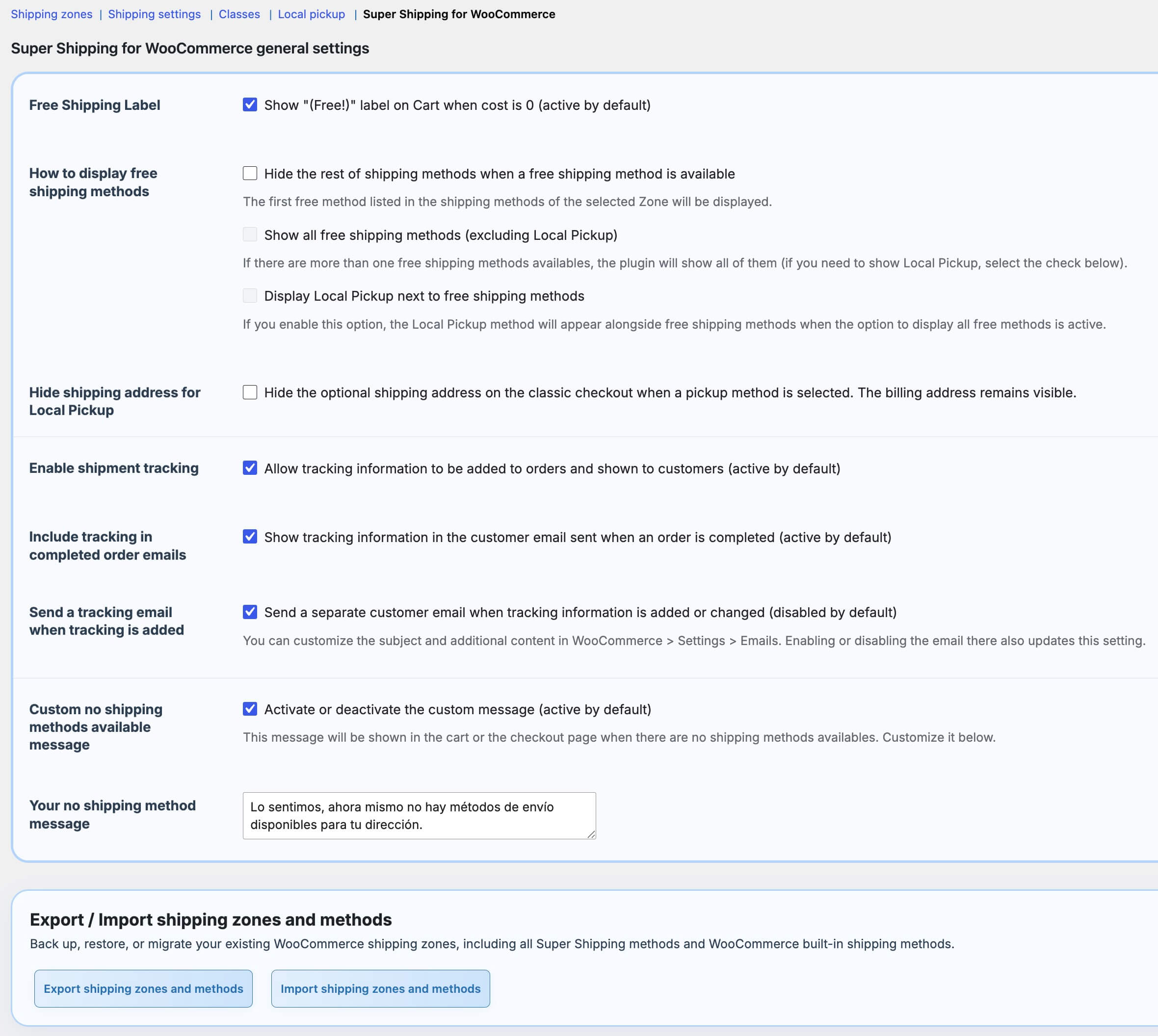
- Free Shipping Label. This checkbox is enabled by default. When a shipping rule has a cost of 0 (for example, when you want to offer free shipping on orders above a certain amount), the word “(Free)” will appear next to the shipping method title, letting customers know that shipping is free. You can disable this option if you've created a specific free shipping method named “Free Shipping”, for example, to avoid displaying the word “Free” twice.
- How to show free shipping methods:
- Hide the rest of shipping methods when free shipping is available. If you enable this option, all other available shipping methods will be hidden when free shipping is available, so customers will only see the free shipping option in their cart. If multiple free shipping methods are available, only the first one in the shipping method list for the selected shipping zone will be displayed.
- Show all free shipping methods (excluding Local Pickup). When this option is enabled, all available free shipping methods will be displayed if there are multiple free shipping methods in the selected shipping zone.
- Display Local Pickup next to free shipping methods. If enabled, Local Pickup will also be displayed alongside free shipping methods when it is available in the selected shipping zone. - Hide shipping address for Local Pickup. If Local Pickup is the only shipping method displayed in the cart, it makes sense to hide the option to enter a separate shipping address on the Checkout page. Enabling this checkbox hides the additional shipping address fields. This option only applies to the classic WooCommerce checkout (the shortcode-based version), as the Gutenberg block-based checkout already includes this behavior by default.
- Enable shipment tracking. This feature allows you to select a shipping carrier, enter a tracking number, and add a direct link to the carrier's website, all from the order edit screen. This makes it easy for customers to track the status of their shipments. You can find more information here. This option includes emails with shipment tracking information:
– Include tracking in completed order emails. If enabled, tracking information will be included in the email sent to the customer when the order is marked as completed.
– Send a tracking email when tracking is added. If enabled, a separate email containing the tracking information will be sent to the customer whenever this information is added or updated. - No shipping methods available message. This field allows you to customize the message that will be displayed on the cart page when there are no available shipping methods for the customer's shipping address.
- Export / Import shipping zones and methods. This action allows you to export or import the entire configuration of shipping zones and methods (including only Super Shipping methods and native WooCommerce shipping methods). You can find more information here.